Shock-Boundary Layer Interaction
High-end aerospace applications often deal with supersonic and hypersonic flows. Extracting work from a high-speed flow requires a careful thermodynamic and aerodynamic analysis. Flow features like shock waves, wall-bounded flows and Shock-Boundary Layer Interaction (SBLI) are an important part of such analysis. Therefore, it is critical to understand the flow-physics in various conditions, if one wants to engineer advanced systems for the purpose of civil and defence aviation. SBLI is an active area of investigation for this reason.
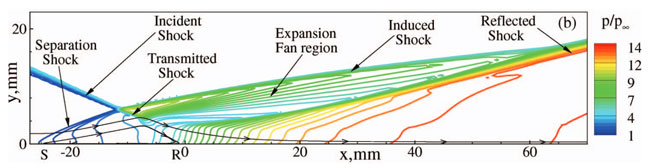
SBLI is produced when a shock wave interacts with the boundary layer. Shock waves and boundary layers are critical in any high-speed flow, but their interaction is of prime importance because it produces flow structures that can be extremely complex. Consequently, SBLI is the focus of many studies. The hypersonic CFD group conducts research on SBLI with an intention to understand the underlying flow-physics and incorporate it into CFD. This approach requires us to work on the fundamental aspects of fluid mechanics, such as shock-turbulence interaction, in order to develop advanced computational models. Models developed by the group are used by industry/academia for practical applications. Shock-unsteadiness (SU) model, developed by Prof. Sinha and used for the simulation of SBLI in high-speed flows, is a fitting example of this research philosophy.
Theoretical analysis of shock dominated flows often considers the shock wave to be a perfect mathematical discontinuity. However, research suggests that the shock wave is an unsteady zone of sharp gradients. The shock wave oscillates about a mean position and distorts because of the upstream turbulence in the flow. This physical phenomenon is called as shock-unsteadiness. The conventional turbulence models, utilized for computing flows with SBLI, do not include the shockunsteadiness effect in their equations. As a result, the SU model was developed to incorporate shock-unsteadiness physics into the existing turbulence models (k-epsilon, Spalart-Allmaras and the k-omega models). The model development is based on a robust mathematical framework (Sinha et al., Physics of fluids, 2003) and flow predictions are more accurate than the standard turbulence models. The SU model is popular and has been utilized to simulate several high-speed flow scenarios. A version of NASA's DPLR code incorporates SU model for simulation of hypersonic flows.
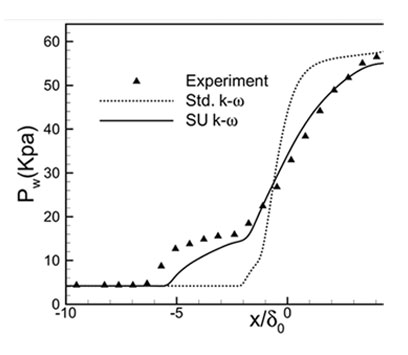
Streamwise variation of surface pressure is plotted here for the case of shock impingement on a flat plate, where the first jump in values suggest the presence of a separation bubble. The standard $k$- $\omega$ model under-predicts separation bubble size. This is due to over-amplification of turbulent kinetic energy across shock waves, leading to greater turbulence in the flow. A more turbulent flow is able to traverse through the adverse pressure gradient region after the shock more easily, producing a delayed separation. In comparison, the SU model predicts lesser amplification of turbulent kinetic energy, resulting in better prediction of separation bubble size and location.