Stability of hypersonic flows
In a laminar flow, the fluid flows in parallel layers, with no disruption between the layers. At low velocities, the fluid tends to flow without lateral mixing, and adjacent layers slide past one another. In comparison, turbulent flows have eddies and rapid mixing of momentum through convection. A non-dimensional number, the Reynolds number (Re), is utilized to characterize the flow as laminar or turbulent. A higher Re flow is usually turbulent, and it represents large momentum convection in comparison to momentum diffusion.
The notion of stability is relevant in scenarios where the flow may transition from laminar to turbulent. A laminar flow is considered to be stable if a small disturbance/perturbation does not affect the flow permanently. In comparison, if the disturbance amplifies, the flow may become turbulent. Stability of a flow is governed by many factors, including surface roughness, body curvature, free-stream disturbance levels, etc.
The hypersonic CFD group studies this phenomenon at a fundamental level. Of particular interest is what effect of fluid properties like viscosity and conductivity have on the stability of high-speed shear flows. Whether an increase in these transport properties, and their relative magnitude can strongly stabilize or destabilize a flow is an area of interest. A deep understanding of flow stability in the hypersonic flow regime can help us predict flow transition in critical applications such as scramjet intakes and re-entry capsules. A transition of flow from laminar to turbulent at a desired location can lead to better flow attachment and mixing of air and fuel in the scramjet. Similarly, better heat transfer and shear stress predictions can be done for re-entry capsules using the stability analysis. This is valuable for thermal protection systems of re-entry capsules.
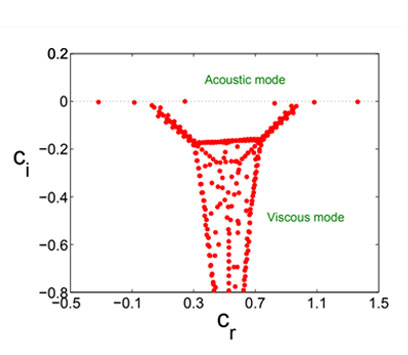
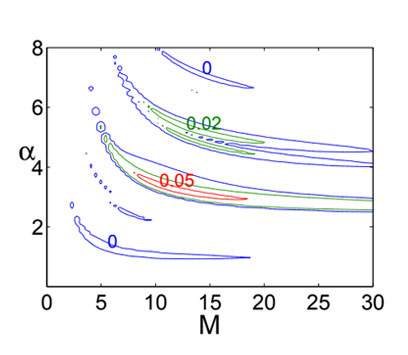
Stability of a flow is analysed as an eigenvalue problem, where the eigenvalues determine conditions for stability. The figure (a) plots the real and imaginary parts of the eigenvalues for a compressible Couette flow. The eigen modes that appear in the Y shaped branch are the viscous modes, and the discrete modes on top of the continuous branch are the acoustic modes with imaginary parts close to zero. These acoustic modes govern the stability of the flow at asymptotic limits, with imaginary part of the eigenvalue greater than zero implies growing or unstable eigenmodes. There exists a least stable mode for a certain combinations of disturbance wavenumber, Mach number and Reynolds number of the flow, which is plotted in figure (b). The regions enclosed by the blue curves represent the unstable zones, and the red colour denotes the maximum growth rate for the range of Mach numbers ($\leq 30$) and disturbance wavenumbers (till 8) considered.
The flow can be stable in the asymptotic limit. However, in short time there can be a substantial energy growth due to the interaction of the non-orthogonal eigenvectors.